In her newly published book, “People-Based Learning: The Future of Learning is Human,” author Jane Shore draws from the cognitive and social sciences to remind us of the importance of “collective intelligence,” the notion that we learn better together.
This concept is more than just a pleasant idea, it’s a biological imperative. Who we learn with and how is at least as important as what we learn. Or as a recent ECLC Summer Institute participant noted following Jane’s workshop: “[Thinking of] our combined cognition as a part of our learning is such an important paradigm shift. It [makes] me realize how important it is for my own learning to be able to learn alongside my peers.”
This is what Power of Place is all about, and why we continue to grow and evolve to meet your needs. In that spirit, I’m writing today to share some of the adjustments we have made to our model that we hope will enrich your experience and growth as an educator.
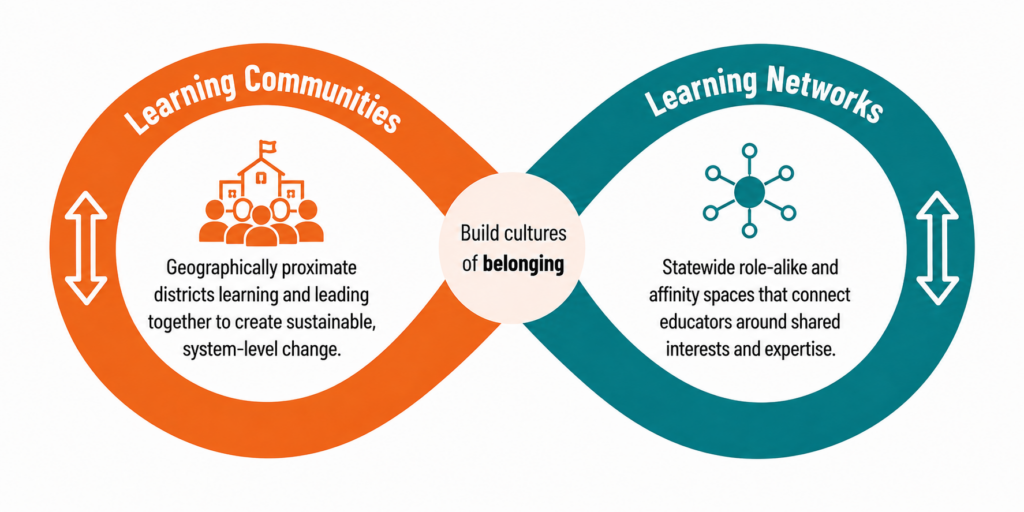
Our new “braided model” is built around our Learning Communities and Learning Networks, the two intentionally connected yet distinct ways we contribute to the state’s education ecosystem.
A Learning Community typically consists of clusters of geographically proximate school districts who come together on a semi-regular basis for learning, collaboration, and community-building. Participants develop the capacity to lead sustainable change, engage in personalized and job-embedded professional learning, and learn alongside colleagues facing similar challenges. Educators at every level of a system have opportunities to share their knowledge with one another, facilitate learning for peers back at their schools, and contribute to a culture of collective growth and continuous improvement. This is what defines our flagship, the Essex County Learning Community, and what will define others that will be launching soon.
A Learning Network is a statewide vehicle for bringing people together with a common interest either in role-alike or affinity-based spaces. Role-alike spaces might look like a group just for principals or just for directors of instruction, while affinity-based spaces might convene educators focused on alternative education or early childhood education. Participants in Learning Networks can register as individuals, making the model highly accessible to any Massachusetts educator. The Teacher Collaborative is our flagship Learning Network, and you will learn about others soon.
Both honor the expertise and professionalism of educators, and both are about building community and learning deeply. They are also mutually reinforcing. Ideas in one could contribute to the development of the other. Moreover, educators can participate in both Learning Networks and Learning Communities, and many already do so. This cross-pollination creates a virtuous cycle of innovation and accelerates system changes.
Our braided model also offers multiple options for educators, through learning experiences that vary widely in duration, content, and intensity. Some provide an accessible entry point through a single event or short series; others require sustained participation over multiple months or years. Some recognize educators’ contributions through honorariums, mini-grants, graduate credit, or Professional Development Points; others do not, but attract participants eager to learn and connect with one another.
In addition, all of our learning experiences are grounded in our four newly-defined Program Principles:
-
- Adaptive Change Leadership: Recognizing the need for adaptive solutions, a collaborative approach that empowers all members of the community in change initiatives, and complex systems thinking about school growth and operation.
-
- Holistic Development and Well-being: Understanding how learners grow and develop,integrating social-emotional learning with academic and cognitive development, and taking into account learners’ overall well-being and sense of belonging.
-
- Equitable Mindsets and Beliefs: Unlearning biases and interrogating systemic inequities while believing learners of all identities, experiences, and affiliations deserve to be fully known and valued.
-
- Inclusive Pedagogies and Practices: Improving all students’ access to high-quality learning environments with universal design and culturally and linguistically sustaining approaches that support learner agency.
Our learning experiences connect through the Program Principles, which are interwoven into everything we do. For example, our “Staying Human in the Age of AI” series may be about AI, but our focus is about exploring its human dimensions, the pedagogical, ethical, cultural, and emotional implications of AI’s presence in education.
More to come on these and other changes in the coming weeks and months, but we wanted you all to be aware of our evolution as the school year begins. These shifts are the result of some big decisions internally based in part on your feedback, and we are excited to show you the impact as we launch this year’s new slate of learning experiences. In the meantime, I would love to hear your thoughts about what I’ve just shared. Please feel free to reach out to me directly at jfeinberg@powerofplacelc.org.
In connection,
Jane